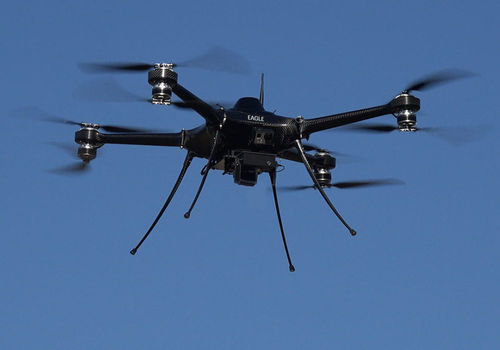
Recently, the American technology company PowerLight announced that its newly developed drone laser wireless power supply device has completed all research and testing work. This device can replenish electric energy through laser beams during drone flight. This technological breakthrough is part of a special plan by the US military aimed at extending the endurance of drones in the air.
From the early focus on improving battery capacity to the current exploration of aerial dynamic recharging modes, insufficient endurance remains the core bottleneck limiting the expansion of drone application scenarios. Currently, consumer-grade drones generally have a single flight duration of 20 to 40 minutes, while industrial-grade models typically have an endurance of 1 to 2 hours, which is difficult to meet the long-duration operational requirements of scenarios such as power inspection, logistics delivery, and ecological monitoring.
To address this core issue, the company's research team has been continuously collaborating with enterprises on technological development. This has facilitated the evolution of endurance technology, encompassing innovations in airframe energy storage, upgrades to ground replenishment, and wireless aerial energy renewal. The synergistic development of multiple technologies provides the driving force for the steady advancement of the low-altitude economy.
The American PowerLight Technology Company has completed the research, development, and testing of a new wireless power system. Source: China Aviation News
Innovation in structural energy storage: Carbon fiber "transformed" into a battery, boosting endurance by 30%
Looking back at the early stages of drone endurance technology development, increasing battery energy density and reducing airframe weight were the two core research and development directions. However, these two traditional technological paths soon encountered development bottlenecks.
Currently, mainstream drones commonly utilize aviation-grade carbon fiber composite materials, which have a density of only one-fourth that of steel and a strength up to seven times that of steel, effectively reducing the self-weight of the drone body. However, the accompanying independent battery system has become a key factor limiting performance improvement. Taking the design of a logistics drone with a load capacity of 5 kilograms as an example, the weight of the accompanying battery accounts for 3 kilograms, and an additional 0.5 kilograms of counterweight is required to maintain flight balance, forming a "contradictory relationship between endurance improvement and load capacity guarantee". Some companies need to reduce the cargo load by 1 kilogram to extend the flight distance by 5 kilometers, and this trade-off in performance has become a common dilemma faced by the industry.
Addressing the limitations of traditional technologies, the research team has turned to the development of "integrated structural energy storage" technology. By incorporating energy storage capabilities into drone body components, they have fundamentally resolved the contradiction between endurance and payload. According to Modern Express, the new carbon fiber structural supercapacitor developed by Nanjing University of Aeronautics and Astronautics has become an important breakthrough in this technological direction, and the relevant research results have been published in the industry journal "Advanced Materials".
The new carbon fiber structure supercapacitor makes it possible for drones to have "the fuselage as the battery". Source: Modern Express
The core innovation of this team lies in the integration of carbon fiber electrodes and epoxy resin-based solid electrolytes, enabling load-bearing components such as drone wings and fuselages to also serve as energy storage devices. During the research and development process, the team optimized the electrolyte ratio. Initially, due to deviations in the ingredient ratio and the influence of laboratory humidity, the energy storage capacity of the samples decreased by 30%. Ultimately, the team adopted a one-step high-temperature mixed hydrothermal method to prepare key materials, formulated the electrolyte according to a specific ratio, and completed the device fabrication in a stable temperature and humidity environment.
The performance of this new composite material meets the expected indicators. Among them, reduced graphene oxide ensures efficient electron transmission, while vanadium oxide enhances the energy storage capacity. With just a functional coating on the surface of carbon fiber, the energy storage capacity can be increased several times. This material possesses three core characteristics: first, pressure resistance. When subjected to the conventional stress of drone wings, the retention rate of energy storage capacity reaches over 80%, and the internal structural compactness is improved under pressure, simultaneously enhancing electron transmission efficiency; second, damage resistance. After damage tests such as blade scratching and drill bit drilling, it can still work normally without short-circuit faults, ensuring energy supply during emergency landing of drones; third, scalability. The energy storage device supports both series and parallel combinations, allowing flexible adjustment of output voltage and energy storage capacity according to demand.
Simulation test data shows that this technology can enable a drone with a payload of 5 kilograms and a range of 20 kilometers to increase its effective payload to 7 kilograms and extend its range to 30 kilometers, while reducing the weight of the accompanying battery from 3 kilograms to 2 kilograms. This can enhance the operational efficiency of a single drone. The team stated that this technology can be extended to applications such as satellite solar panel brackets and aircraft cabin interior walls in the future; if it can maintain over 80% performance at temperatures below minus 30 degrees Celsius, its application scope will be further expanded.
Ground supply network: Magnetic charging station supports drone operations for 24 hours
Structural energy storage technology has addressed the core issue of energy storage for drones themselves. However, in long-duration and large-scale operation scenarios, external replenishment is still required to ensure continuous operation. Frequent manual battery replacement not only increases operational costs but also reduces operational efficiency, limiting the improvement of drone automation levels.
Against this backdrop, the ground-based automated replenishment system centered around drone nests has gradually developed. Through technologies such as autonomous takeoff and landing, automatic charging, etc., an automated energy replenishment network has been established, serving as a crucial technical support to overcome the endurance bottleneck.
Currently, mainstream drone nests primarily fall into two categories: one is the mobile nest converted from inspection vehicles, and the other is the fixed nest installed on top of poles and towers. The technology of mobile nests is relatively mature and has been piloted in multiple regions across the country; fixed nests, on the other hand, focus on specific scenarios such as line inspection and are continuously overcoming technical challenges.
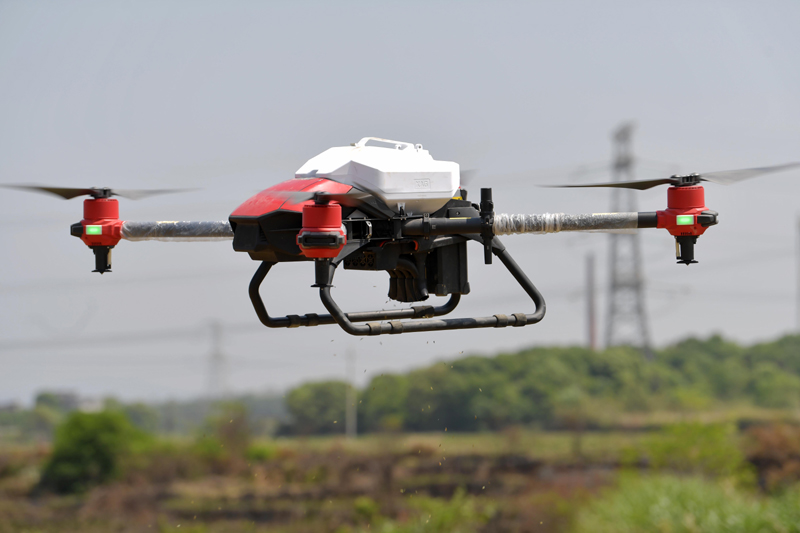
The drone performs inspection tasks according to the set flight path. Source: Changjiang Daily
Industry inspections have long faced pain points such as dependence on professional drone pilots, heavy workload in manual data collation, and delayed response to emergencies. Additionally, ground-based drone nests suffer from limited coverage issues. To address these challenges, the development direction of "nests on towers" has emerged for fixed drone nests. Leveraging the distribution characteristics of transmission towers along the line, it achieves autonomous drone patrols along the entire line.
This direction integrates multiple technological innovations: in terms of charging solution, it abandons the high-precision and high-cost mechanical arm battery replacement mode and adopts magnetic contact charging. The drone is guided to slide into the dock through a spring-loaded parking pad, and charging can be completed in 30 minutes, significantly simplifying the process. In terms of structural design, a CD-disc-style parking pad is adopted, installed inside the iron tower. It opens to the side when in use and retracts when idle, avoiding the risk of colliding with the tower and the problem of unstable center of gravity. Functionally, it integrates a data base station, supports remote control, and the drone can independently complete patrols, return for charging, data transmission, and hidden danger alarms.
At the end of 2022, the "Smart Patrol Cube" drone nest developed by Wuhan Yixun Technology Co., Ltd. was put into application on the 500 kV Shaliu line of the Southern Power Grid's ultra-high voltage Liuzhou bureau, becoming the first ultra-high voltage transmission line in China to achieve autonomous drone patrol. This model has been implemented in power grid patrol scenarios in Fujian, Hainan, Henan, Guangxi, and other regions.
Ground recharging technology has been implemented in multiple fields. The automatic charging equipment for drones launched by Yucheng Spacetime is a system that integrates precise guidance, efficient power transmission, and intelligent operation and maintenance management. Drones achieve autonomous landing through visual navigation or RTK technology, and the positioning compensation technology equipped in the system can accommodate centimeter-level landing deviations, ensuring precise docking with the charging module.
Relying on magnetic resonance coupling technology, this device boasts an electric energy transmission efficiency of up to over 90%, comparable to wired charging speeds. Furthermore, it features no exposed metal contacts, effectively avoiding short circuits and poor contact issues caused by rain, dust, and metal oxidation. With a protection level of IP67, the device can operate stably in complex environments such as farmland wetlands, snowy and icy weather, and salt spray corrosion, supporting uninterrupted drone operations 24/7. This technology has a wide range of application scenarios. In the field of power inspection, the deployment of charging piles along the route can significantly shorten inspection cycles. In the field of smart agriculture, it enables a "short-time charging, long-time operation" cycle for plant protection drones. In the field of security patrols, it ensures that drones can automatically return for charging when battery levels are low and maintain continuous duty.
According to Research Nester, the global drone charging facility market is projected to surpass a value of $525 million in 2025, and is anticipated to climb to over $1.03 billion by 2035, maintaining a compound annual growth rate (CAGR) of over 7% from 2026 to 2035. China holds approximately 70% of the global civilian drone market, and as a core manufacturing hub, its continuous investment in charging infrastructure has further expanded the market growth potential.
Aerial wireless energy replenishment: Laser-powered testing achieves dynamic energy replenishment from a distance of over a kilometer
Although ground-based nest replenishment has improved the continuity of drone operations, it is limited by deployment scope and difficult to adapt to scenarios such as remote areas and long-distance flights. Aerial wireless energy transfer technology, by simulating the aerial refueling mode of manned aircraft, achieves dynamic energy replenishment for drones in flight, promising to eliminate the dependence on traditional batteries and ground charging facilities. Multiple technical routes, such as laser energy transfer and radio frequency energy transfer, are moving from laboratory prototypes to the stage of practical testing and verification.
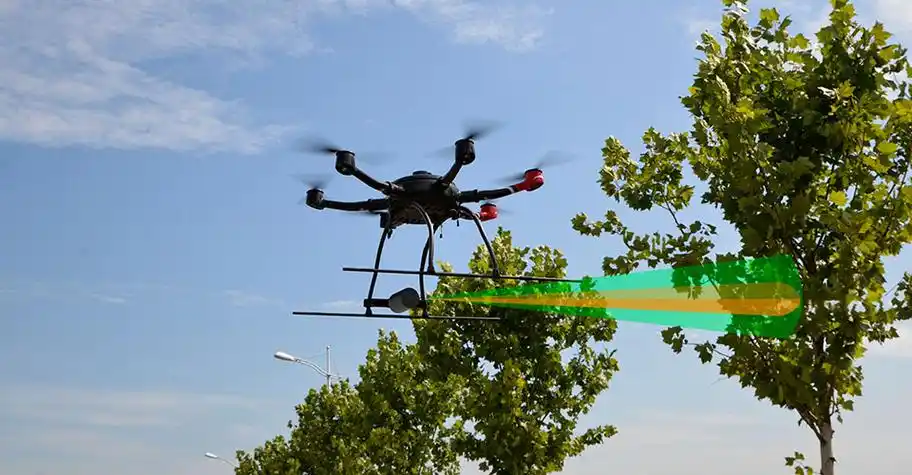
The laser wireless power supply device developed by PowerLight, a US company, has achieved a significant breakthrough. This technology is advanced through the "Laser Powering Drones" project, with its core consisting of high-power laser emitting equipment and lightweight on-board receiving terminals. It can deliver kilowatt-level power to drones located several miles away.
Schematic diagram of laser wireless power transmission technology for unmanned aerial vehicles. Source: China Defense Daily
After testing, the launch equipment has demonstrated capabilities such as precise target tracking and flexible deployment. Its power supply effectively covers an airspace of 1,500 meters. The system is equipped with multiple protection mechanisms and is compatible with existing drone control systems. Its compact airborne receiver, weighing approximately 2.72 kilograms, can convert laser into electrical energy and transmit telemetry data. Currently, the company is collaborating with Kraus Hamdani Aerospace to advance the integration and adaptation of the system with the K1000 ULE long-endurance drone. Preparations are underway for a full-system integrated flight test in early 2026, with the goal of achieving unlimited endurance in a controlled environment.
The technology of wireless power transmission in the air is developing in parallel along multiple paths. In January 2025, the American company GuRu launched a modular radio frequency wireless power transmission system, which transmits power through the 24GHz frequency band with a maximum transmission distance of 9 meters. Under optimal conditions, it can support drones to hover continuously for 96 hours. However, it has a shortcoming of performance degradation due to interference in outdoor environments.
Domestic research teams have also achieved remarkable results. In March 2025, the Jiufengshan Laboratory released self-developed gallium nitride chips and devices, completing the world's first preparation of 8-inch silicon-based gallium nitride wafers with nitrogen polarity. The product's power density is 2 to 3 times higher than that of traditional materials, and the cost is reduced by more than 30%. It can support dynamic wireless energy replenishment for drones within a range of 20 meters. The commercially available 100-nanometer silicon-based gallium nitride PDK released at the same time provides design support for downstream manufacturers.
Adaptive wireless energy transfer technology represents a significant breakthrough direction. The related technology jointly developed by Xidian University and Southeast University utilizes dual-frequency metasurfaces and convolutional neural networks as the core to achieve centimeter-level positioning and tracking-based wireless energy transfer through the air. The adaptive wireless energy transfer network constructed by this technology can simultaneously complete target sensing and positioning, beam steering, and energy transmission. The metasurface adopts a dual-frequency co-aperture design, utilizes second-order harmonics to achieve near-field positioning with a resolution of 3 centimeters, and the electromagnetic metasurface can adjust electromagnetic wave parameters in real time, supporting stable non-contact charging for drones in motion. Theoretically, it can be extended to multi-target synchronous power supply.
The technology of wireless energy transfer through the air has undergone long-term research and development. In 2005, NASA of the United States achieved the first sustained flight of a drone powered by laser energy transfer. Subsequently, Japanese and American institutions have carried out experiments on optical fiber and laser energy transfer. Domestic institutions such as Beijing Institute of Technology and Shandong Aerospace Electronics have verified the technical feasibility of laser energy transfer through experiments, achieving a maximum laser-to-electric energy conversion efficiency of 48%. In the future, with technological iteration, wireless energy transfer through the air is expected to achieve multi-target synchronous power supply, expand to multi-drone cluster applications, provide new supply solutions for logistics and distribution, agricultural plant protection, and other fields, and promote the development of drone endurance towards unlimited endurance.